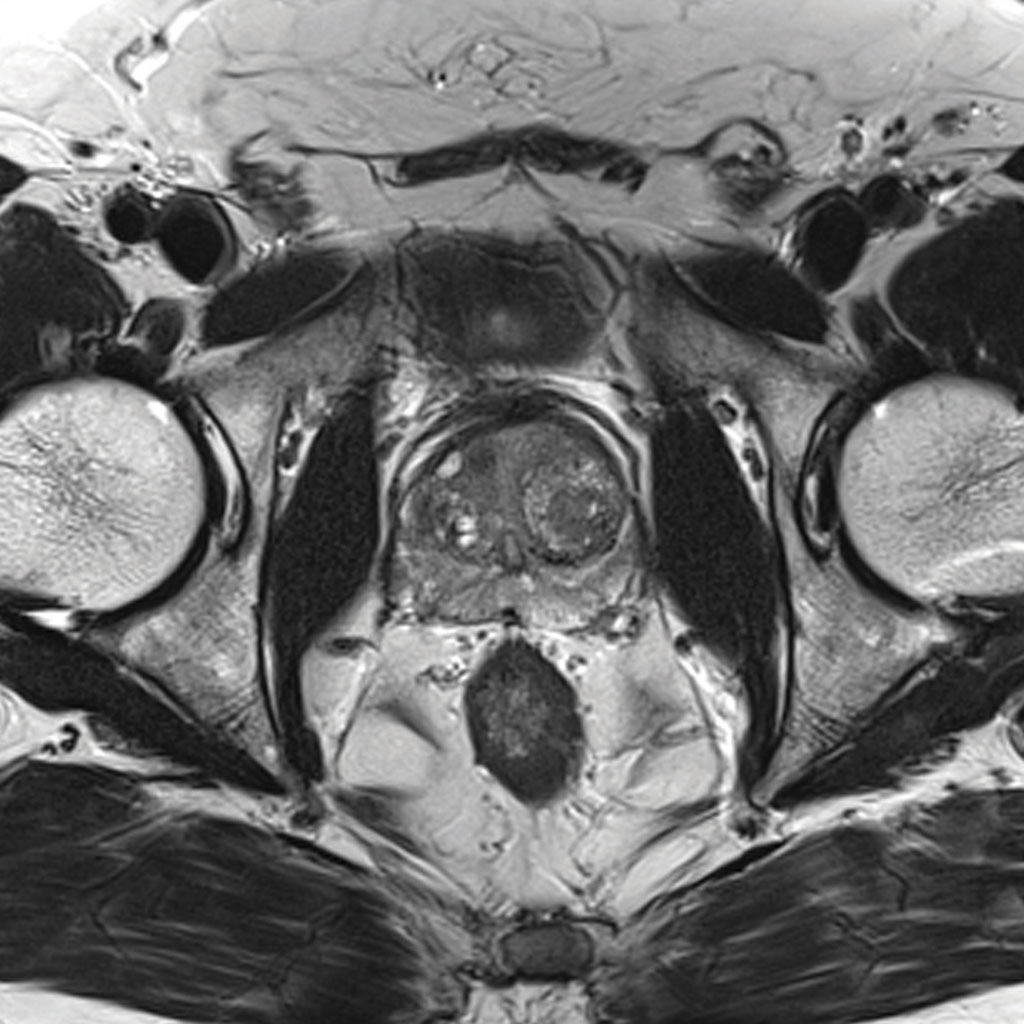
September is Prostate Cancer Awareness Month, and the part of that conversation worth spending time on is not the PSA test itself, which most men have heard of. It is what happens after a PSA comes back elevated.
The Problem With Going Straight to Biopsy
An elevated PSA is not a diagnosis. PSA rises with prostate cancer, and it also rises with benign enlargement, with inflammation, with infection, and simply with age. A large share of men with an elevated PSA do not have cancer at all.
For a long time the standard next step was a systematic biopsy, meaning a set number of samples taken from mapped locations across the prostate without any picture of where a suspicious area might be. That approach works, and it has two well-documented weaknesses. It can miss clinically significant cancers that happen to sit between sampling points, and it can find small, slow-growing cancers that were never going to cause harm, which then leads to treatment and side effects the patient did not need.
What a Prostate MRI Shows
A multiparametric prostate MRI combines several different imaging sequences, each measuring something different about the tissue. One shows anatomy in fine detail. Another measures how freely water molecules move through the tissue, which changes when cells are densely packed the way they are in an aggressive tumor. A third tracks how contrast moves in and out, since tumors tend to develop their own blood supply.
No single sequence is decisive. Read together they let a radiologist identify areas that look suspicious and, importantly, distinguish the ones that look aggressive from the ones that do not.
PI-RADS, and What the Number Means
Prostate MRI findings are reported using a standardized scale called PI-RADS, which runs from 1 to 5. A low score means clinically significant cancer is very unlikely in that area. A high score means it is likely. Scores in the middle are genuinely indeterminate and are interpreted alongside your PSA, your prostate volume, your history, and your physician’s judgment.
The scale exists so that reports from different radiologists mean the same thing, and so that the same lesion can be compared meaningfully over time if a man is being monitored rather than treated.
How It Changes What Happens Next
A prostate MRI done before biopsy can change the plan in two directions.
If the MRI shows nothing suspicious, a man and his urologist may reasonably decide to monitor with repeat PSA testing rather than proceed to biopsy immediately. That is a real benefit, since a prostate biopsy is not a trivial procedure and carries its own risks.
If the MRI does show a suspicious area, the biopsy that follows can be targeted at it rather than sampling blindly. In a targeted biopsy the MRI images are registered to live ultrasound so the needle can be directed at the specific lesion, which improves the odds of finding an aggressive cancer and of grading it correctly.
What a Prostate MRI Exam Is Like
It is an MRI, so the general experience is the one described in our earlier article on MRI scans, including the noise, the need to stay still, and the safety screening about metal and implanted devices.
A few things are specific to the prostate. The exam typically runs 30 to 45 minutes. Contrast through an IV is used in many protocols. You may be asked to avoid ejaculation for a few days beforehand and to empty your bowel and bladder before the scan, because motion from the rectum and a full bladder both degrade the images. If you have had a recent biopsy, the timing matters, since bleeding in the gland can obscure the picture for several weeks, which is one reason the MRI is best done before the biopsy rather than after.
Tell the scheduler about any hip replacement. Metal near the prostate can distort the images, and the protocol may need to be adjusted.
Who Should Ask About Prostate MRI
If your PSA came back elevated and a biopsy has been recommended, ask your urologist whether an MRI first would change the plan. If you are already on active surveillance for a low-grade cancer, ask what role MRI plays in your follow-up. If a previous biopsy was negative but your PSA is still rising, that is one of the situations where MRI is most useful.
The decision belongs to you and your urologist. What imaging contributes is a clearer picture to make it with.
References
American College of Radiology. Prostate Imaging Reporting and Data System (PI-RADS). acr.org
RadiologyInfo.org. Prostate Cancer Diagnosis and MRI. radiologyinfo.org
American Urological Association. Early Detection of Prostate Cancer Guideline. auanet.org