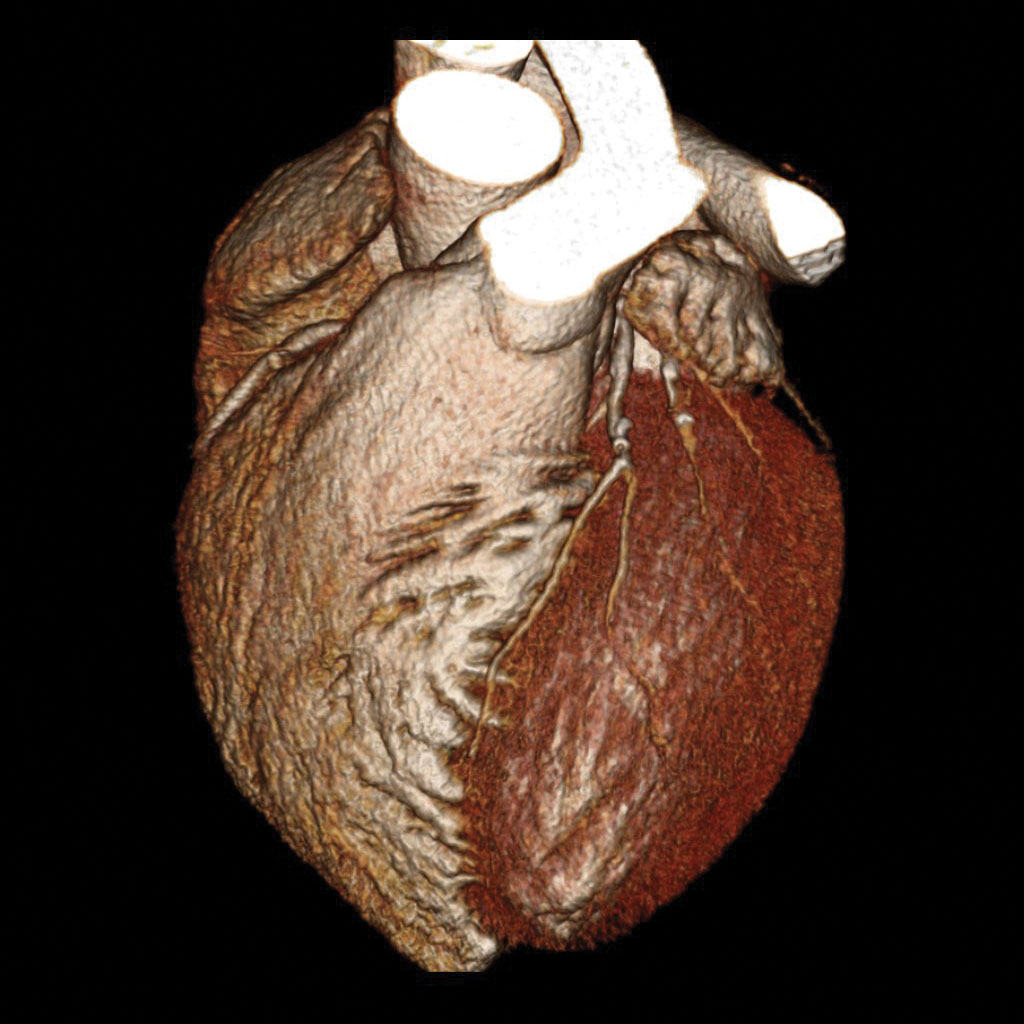
February is American Heart Month, which makes it a reasonable time to talk about a test that sits in an unusual spot, coronary calcium score. It is quick, it involves no needles, and it answers a question that cholesterol numbers and blood pressure readings often leave unresolved.
What the Test Is
A coronary calcium score is a CT scan of the heart done without contrast dye. The scanner takes a series of images timed to your heartbeat, and a computer identifies and measures calcified plaque in the walls of the coronary arteries. The result is a single number, the Agatston score.
The scan takes only a few minutes. You lie on the table, ECG leads are placed on your chest, and you hold your breath for about ten seconds while the images are acquired. There is no IV, no contrast, no preparation, and no recovery. You drive yourself home after your coronary calcium score.
Why the Number Matters
Calcified plaque is a direct marker of atherosclerosis. It is not a prediction based on your age and your lab values, it is a picture of what has actually accumulated in your arteries.
That distinction is the whole point. Standard risk calculators estimate your ten-year risk of a heart attack or stroke from age, sex, cholesterol, blood pressure, smoking status, and diabetes. Those estimates are useful, and they are also averages drawn from large populations. Two people with identical risk-calculator scores can have very different amounts of plaque, and the coronary calcium score is what tells them apart.
A score of zero is meaningful in its own right. It indicates no detectable calcified plaque, and research has consistently found that people in this group have low near-term event rates. A high score, particularly at or above 100, moves a person into a category where the benefit of treatment is clearer.
Who It Is For
The 2018 American College of Cardiology and American Heart Association cholesterol guideline, reaffirmed in the 2019 primary prevention guideline, describes calcium scoring as reasonable for adults aged 40 to 75 with LDL cholesterol between 70 and 189, who fall at intermediate estimated risk, meaning a ten-year risk of 7.5 percent to under 20 percent, or at borderline risk of 5 percent to under 7.5 percent in selected cases, when the decision about starting a statin remains uncertain after the usual risk assessment.
That last clause carries the weight. The coronary calcium score is not meant for someone whose risk is clearly low or clearly high, because the answer in those cases is already known. It is meant for the large group in the middle, where a physician and a patient are genuinely undecided and want something more specific to go on.
Coronary calcium score is also not a test for someone with chest pain or other symptoms of heart disease. Symptoms call for a different workup entirely, and anyone experiencing them should be evaluated rather than scheduled for a screening scan.
What It Does Not Tell You
A coronary calcium score measures calcified plaque and nothing else. It does not show whether an artery is narrowed enough to limit blood flow, and it does not detect soft, non-calcified plaque, which matters particularly in younger patients whose disease has not yet calcified. A coronary calcium score of zero lowers the estimate of risk, and it is not a guarantee.
The scan involves a small amount of radiation, less than many routine CT exams but not zero. As with any chest imaging, findings unrelated to the heart occasionally turn up in the lungs or elsewhere in the scanned field, and those are reported and followed up as appropriate.
Coverage
Calcium scoring is frequently not covered by insurance, because it is used as a risk-refinement tool rather than a diagnostic test, and coverage varies considerably from plan to plan. Many centers offer it at a modest self-pay price for that reason. Ask what applies to your plan before scheduling rather than after.
The Conversation to Have
If you are somewhere in the middle on cardiovascular risk, if you have been going back and forth with your doctor about whether to start a statin, or if you have a family history that worries you more than your lab results suggest it should, this is a reasonable question to raise at your next visit.
Ask your physician whether a coronary calcium score would change what the two of you decide to do. If the answer is no, the scan is not worth having. If the answer is yes, it is a few minutes on a CT table for a number that makes the rest of the conversation concrete.
References
Grundy SM, et al. 2018 AHA/ACC Multisociety Guideline on the Management of Blood Cholesterol. Circulation. ahajournals.org
Arnett DK, et al. 2019 ACC/AHA Guideline on the Primary Prevention of Cardiovascular Disease. Circulation. ahajournals.org
RadiologyInfo.org. Cardiac CT for Calcium Scoring. radiologyinfo.org